

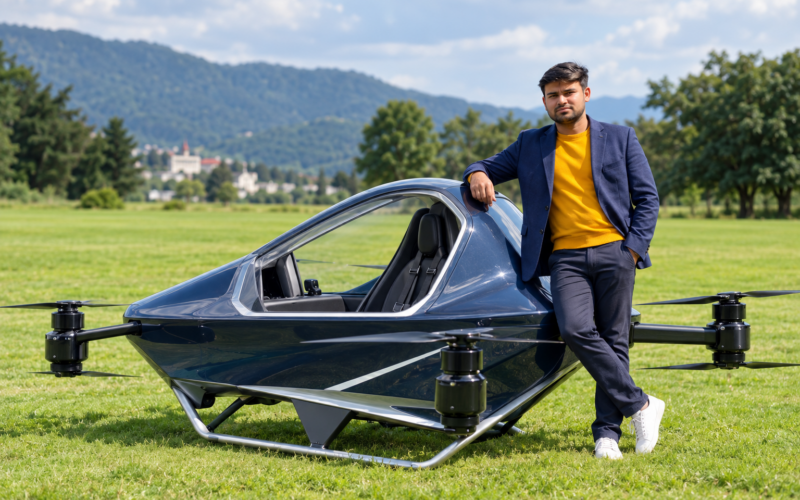
Corporate India is facing a self-inflicted talent crisis, and industry strategists warn that organizations have a narrowing window to fix their broken applicant tracking systems before they stifle innovation entirely. Modern companies strictly demand exact-match pedigrees, filtering out any professional who has not held the precise title they are applying for. Yet, this rigid gatekeeping is being rapidly dismantled by grassroots innovators, most visibly demonstrated by the recent success of the Ravi Tamta flying car.
Operating out of Uttarakhand, a man with a Bachelor of Arts degree achieved what heavily funded aerospace firms spend millions trying to do. The Ravi Tamta flying car is a functional electric vertical takeoff and landing vehicle built without a degree in aeronautical science, manufacturing, or physics. It required 13 years of relentless, self-directed experimentation. While this breakthrough is a triumph for mobility, talent advocates are using it to mount a fierce challenge against the corporate obsession with formal credentials.
Today’s hiring managers operate on a stubborn, exclusionary logic. If an organization wants an HR professional, they demand someone who has only ever worked strictly in HR. This automatically locks out candidates who have spent years training HR teams, developing HR communications, or managing compliance. A psychology graduate is academically trained to decode human behavior, manage conflict, and analyze cognitive biases—skills fundamental to human resources. Yet, they are rejected in favor of someone who simply knows standard administrative compliance.
The same siloed thinking infects communications. An organization looking for a content writer will aggressively reject a technology graduate who writes beautifully, opting instead for a pure writer who does not natively understand the software or the product architecture. They prioritize the historical job title over the actual capability.
Critics argue this rigid filtration is built on glaring hypocrisy, noting that the demand for strict pedigrees suddenly vanishes at the C-suite level. Consider Infosys. Today, Shaji Mathew serves as the Chief Human Resources Officer for the tech giant. However, the company never looked at his traditional HR pedigree; he was previously a business delivery leader. When executives pivot, it is lauded as cross-functional brilliance and “bringing business acumen” to a new domain. But when mid-level professionals attempt identical lateral moves, they are punished by a system that refuses to look past their previous titles.
The engineering behind the Ravi Tamta flying car proves that complex skills are highly transferable. A candidate who has spent years in policy brings a strategic lens to HR, just as a self-taught innovator brings fresh mechanics to aviation.
Despite these contradictions, corporate recruitment leaders continue to defend their gatekeeping. They argue that strict domain experience minimizes onboarding time and guarantees immediate operational safety. But as the Ravi Tamta flying car prepares for further regulatory testing, the message to corporate recruiters is clear. If a self-taught individual can engineer the Ravi Tamta flying car without a specialized degree, it is time to stop confusing a piece of paper with human potential.
