

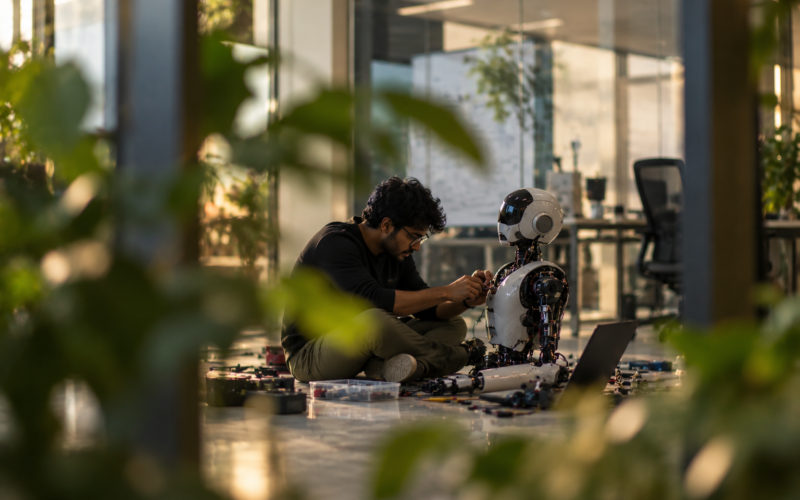
Here is the story: Kabir wiped the sweat from his forehead. He stood at the edge of the Kashmir apple orchard and watched a small robotic rover navigate the uneven soil. Aisha walked behind the machine, holding a tablet that tracked its spatial data.
“It works,” Kabir said. He sounded more relieved than excited. “The decentralized network actually helps it identify the ripe apples without bumping into the trunks. We don’t even need heavy, localized servers to run it.”
“Of course it works,” Aisha smiled. “Startups like Auki Labs map the spatial intelligence, while Rice AI crowdsources the training data. The real-world data from the decentralized grid gives it a perfect baseline to navigate complex environments.”
Kabir crossed his arms. He looked around the vast orchard where local laborers picked apples by hand. “I cannot stop thinking about them,” he admitted. “Tech giants like SoftBank and Figure AI are pouring billions into automating manual labor. Are we just putting these workers out of a job entirely?”
Aisha stopped typing and looked up. “People always fear that, but you are confusing traditional automation with this new era. In the past, companies relied on rigid, deterministic coding and massive computing power—often utilizing expensive hardware from Nvidia—to pre-program every single robotic movement. If a traditional robot encountered an unexpected obstacle, a software engineer had to manually rewrite its code. Today, Physical AI is fundamentally different. It relies on neural networks, spatial awareness, and Decentralized Physical Infrastructure Networks to learn autonomously. Because the machine understands its physical environment dynamically, an everyday worker does not need to know complex computer programming to manage it. They just use intuitive, AI-assisted interfaces to guide the autonomous system.”
“So, instead of replacing them, it shifts their role?” Kabir asked.
“Exactly,” she explained. “When advanced robots take over the most strenuous and repetitive tasks, companies must hire dedicated teams to manage them in the real world. Manual machine operators transition into robot technicians. Logistics workers coordinate entire fleets of mobile machines. The people currently picking apples could become the fleet managers who oversee these rovers.”
Kabir watched the laborers closely. “So, you are saying the industry will create entirely new roles?”
“Absolutely,” Aisha nodded. “Globally, the demand is exploding for system management, predictive maintenance, and human-machine collaboration. Businesses simply cannot deploy Physical AI without training everyday people to maintain, optimize, and supervise the hardware.”
“But what about the skills gap?” Kabir challenged. “A farmer knows agriculture, not advanced robotics.”
“That is exactly why the intuitive nature of this new tech matters,” Aisha countered. “Because the autonomous robots handle the complex execution, working alongside Physical AI drastically lowers the barrier to entry for technical jobs. Furthermore, decentralized organizations like XMAQUINA are actively pooling community capital to democratize access. They ensure smaller agricultural teams can adopt, own, and manage the hardware easily without relying on predatory corporate contracts.”
Kabir looked back at their rover. It successfully navigated around a large rock without any human intervention. Employment in highly automated warehouse facilities has actually grown over the last decade. Those facilities ship higher volumes and require large human support teams to audit inventory and fix mechanical jams. The exact same transition will happen in agriculture and construction.
“We just need to make sure we build the right educational tools to train them,” Kabir said.
“That is step two,” Aisha smiled. “We have to prepare our local workforce to scale Physical AI safely. But first, let’s make sure this machine can actually pick an apple without bruising it.”
As the machine gently plucked a perfect red apple from the branch, the answer to Kabir’s initial worry became crystal clear. Rather than erasing the human workforce, this unprecedented technological shift will unequivocally open new, evolved labor opportunities across every major industry.
What are you thinking now? Does it make it a little less darker?
