
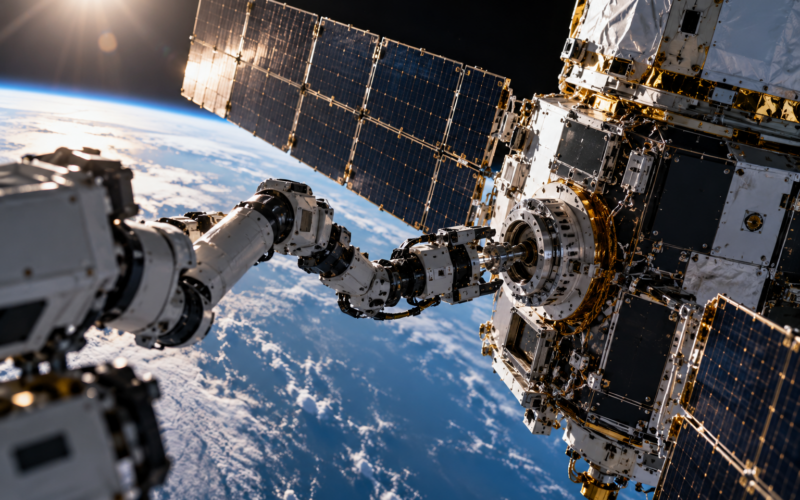
The commercial space race has traditionally been defined by launch capabilities—getting mass into orbit as cheaply and reliably as possible. But as the low-Earth orbit ecosystem becomes increasingly crowded with mega-constellations and aging satellites, a new, highly lucrative market is opening up: in-orbit servicing. The latest entrant making serious waves is Sinxbot, a Chinese space robotics startup that just secured hundreds of millions of yuan (equivalent to tens of millions of US dollars) across three rapid-fire funding rounds. This aggressive capital accumulation culminated in a Series A led by massive tech and telecommunications heavyweights: Alibaba and the China Mobile Industry Chain Fund.
Incubated by a specialized research team from Tsinghua University and the Jianghuai Frontier Technology Collaborative Innovation Center, Sinxbot is tackling the intensely complex logistics of maintaining infrastructure in the vacuum of space. Their core technology revolves around cable-driven, flexible space robots explicitly designed for three critical operational missions: on-orbit refueling, on-orbit inspection and repair, and assisted deorbiting.
The strategic backing behind this startup is just as fascinating as the underlying robotics. When enterprise giants like Alibaba and China Mobile aggressively invest in early-stage space technology, it signals a decisive shift from theoretical government-funded science projects to tangible commercial demand. China’s broader space policy is actively pushing to transition national infrastructure ambitions into a self-sustaining commercial ecosystem. For major telecommunications providers operating massive, expensive satellite networks, the ability to routinely refuel and repair a multi-million-dollar asset rather than replacing it outright fundamentally alters the unit economics of space-based communications.
Operating robotics in space is notoriously difficult. Unlike industrial robotic arms anchored to a solid factory floor, space manipulators must function in a zero-gravity, free-floating environment. Every movement of the robotic arm introduces complex dynamic coupling and momentum shifts that can easily destabilize the host spacecraft. Sinxbot’s approach utilizes flexible, cable-driven architectures specifically developed over two decades to manage these physical constraints. They are now actively preparing for a critical space rendezvous and docking technology demonstration slated for 2027.
The inclusion of strategic industrial investors like Agibot and Trina Solar in the company’s earlier angel rounds further highlights the deep cross-pollination happening between terrestrial robotics, advanced solar energy, and commercial aerospace.
Furthermore, Sinxbot’s assisted deorbiting capability addresses a rapidly looming crisis: the proliferation of space debris. With the sheer volume of hardware currently being launched globally, the ability to safely remove defunct satellites is rapidly transitioning from a theoretical environmental concern to a strict regulatory necessity. Spacecraft capable of autonomously capturing and deorbiting non-cooperative, tumbling targets are effectively positioning themselves to become the highly-paid sanitation and utility companies of the future orbital economy.
If Sinxbot’s 2027 on-orbit demonstration is successful, this influx of capital will be seen as the moment the foundational layer of a true, commercial off-world maintenance economy was established.
