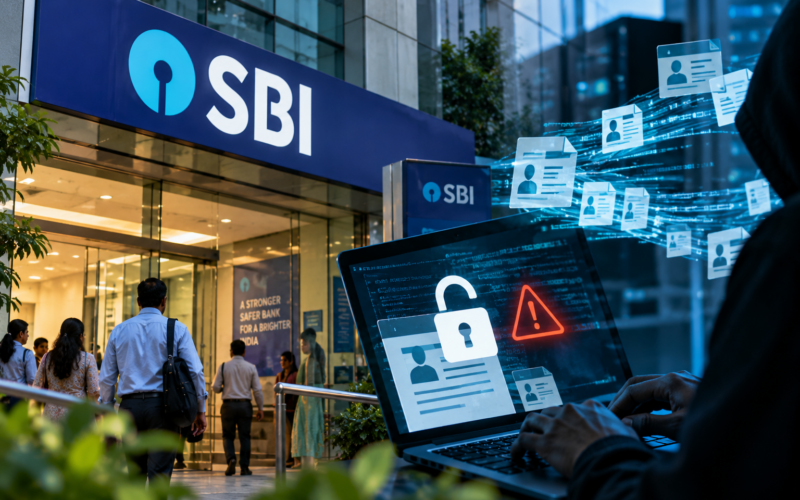
SBI India Data Leaks 3,897 Records Expose Core Banking Flaws

The State Bank of India (SBI), the nation's largest public sector lender, has officially confirmed a highly concerning cybersecurity incident. Reports have surfaced that 3,897 customer records were discovered floating on the dark web, prompting an immediate internal investigation. While the absolute number of affected accounts might seem mathematically insignificant compared to the bank's massive customer base of nearly half a billion people, this SBI data leak represents a critical vulnerability in the foundational infrastructure of India's legacy banking system. When a financial institution of this immense scale suffers a breach, the focus should not merely be on the volume of the compromised data, but on the specific vector of the attack. Cybercriminals do not typically breach tier-one bank mainframes to steal a mere four thousand records. Often, a targeted SBI data leak of this precise size acts as a proof-of-concept, a reconnaissance mission, or a warning shot fired by highly sophisticated threat actors. It exposes the fragile seams where legacy, decades-old core banking architecture attempts to seamlessly interface with modern, API-driven digital banking applications, mobile interfaces, and an ever-expanding network of third-party vendors. For the broader fintech ecosystem and digital economy, this incident is a glaring reminder that strict regulatory compliance does not automatically equal actual cybersecurity. Modern financial startups are frequently subjected to intense regulatory scrutiny by the central bank regarding data localization and security protocols. Yet, this SBI data leak illustrates that the ultimate single point of failure often resides within the legacy institutions that actually hold the capital. Startups spend millions building beautiful, frictionless interfaces, but they are ultimately tethered to traditional banks that are actively struggling to secure increasingly complex, sprawling digital perimeters against relentless dark web syndicates. The attack surface is simply getting too large to manage with traditional IT protocols. Furthermore, the ramifications of the breach extend far beyond the immediate need to reissue a few thousand compromised credentials or freeze specific accounts. In the current macroeconomic climate, where digital payments, unified interfaces, and digital public infrastructure form the very backbone of the rapidly growing Indian economy, systemic trust is an absolute necessity. An incident like the SBI data leak severely undermines consumer confidence at a foundational level. It sends a chilling message to the average depositor: if the largest, most heavily guarded, and heavily capitalized public bank in the country cannot keep highly sensitive customer data off illicit marketplaces, what hope do smaller regional banks or nascent digital wallets have against these same bad actors? Moving forward, the crisis management response from the State Bank of India must be radically transparent. A standard corporate press release minimizing the operational impact will no longer suffice for a digitally native consumer base. To restore absolute confidence, the institution must publicly detail the exact technical vulnerabilities that facilitated this SBI data leak and heavily outline the concrete architectural upgrades being implemented to seal them. In the high-stakes arms race of global cybersecurity, legacy banks can no longer afford to treat data breaches as inevitable public relations hurdles; they must treat them as existential threats to the entire financial ecosystem.

The State Bank of India (SBI), the nation’s largest public sector lender, has officially confirmed a highly concerning cybersecurity incident. Reports have surfaced that 3,897 customer records were discovered floating on the dark web, prompting an immediate internal investigation. While the absolute number of affected accounts might seem mathematically insignificant compared to the bank’s massive customer base of nearly half a billion people, this SBI data leak represents a critical vulnerability in the foundational infrastructure of India’s legacy banking system.

When a financial institution of this immense scale suffers a breach, the focus should not merely be on the volume of the compromised data, but on the specific vector of the attack. Cybercriminals do not typically breach tier-one bank mainframes to steal a mere four thousand records. Often, a targeted SBI data leak of this precise size acts as a proof-of-concept, a reconnaissance mission, or a warning shot fired by highly sophisticated threat actors. It exposes the fragile seams where legacy, decades-old core banking architecture attempts to seamlessly interface with modern, API-driven digital banking applications, mobile interfaces, and an ever-expanding network of third-party vendors.

For the broader fintech ecosystem and digital economy, this incident is a glaring reminder that strict regulatory compliance does not automatically equal actual cybersecurity. Modern financial startups are frequently subjected to intense regulatory scrutiny by the central bank regarding data localization and security protocols. Yet, this SBI data leak illustrates that the ultimate single point of failure often resides within the legacy institutions that actually hold the capital. Startups spend millions building beautiful, frictionless interfaces, but they are ultimately tethered to traditional banks that are actively struggling to secure increasingly complex, sprawling digital perimeters against relentless dark web syndicates. The attack surface is simply getting too large to manage with traditional IT protocols.

Furthermore, the ramifications of the breach extend far beyond the immediate need to reissue a few thousand compromised credentials or freeze specific accounts. In the current macroeconomic climate, where digital payments, unified interfaces, and digital public infrastructure form the very backbone of the rapidly growing Indian economy, systemic trust is an absolute necessity. An incident like the SBI data leak severely undermines consumer confidence at a foundational level. It sends a chilling message to the average depositor: if the largest, most heavily guarded, and heavily capitalized public bank in the country cannot keep highly sensitive customer data off illicit marketplaces, what hope do smaller regional banks or nascent digital wallets have against these same bad actors?

Moving forward, the crisis management response from the State Bank of India must be radically transparent. A standard corporate press release minimizing the operational impact will no longer suffice for a digitally native consumer base. To restore absolute confidence, the institution must publicly detail the exact technical vulnerabilities that facilitated this SBI data leak and heavily outline the concrete architectural upgrades being implemented to seal them. In the high-stakes arms race of global cybersecurity, legacy banks can no longer afford to treat data breaches as inevitable public relations hurdles; they must treat them as existential threats to the entire financial ecosystem.

By StartupByline

Leave a Reply

Your email address will not be published. Required fields are marked *

Toggle Dark Mode